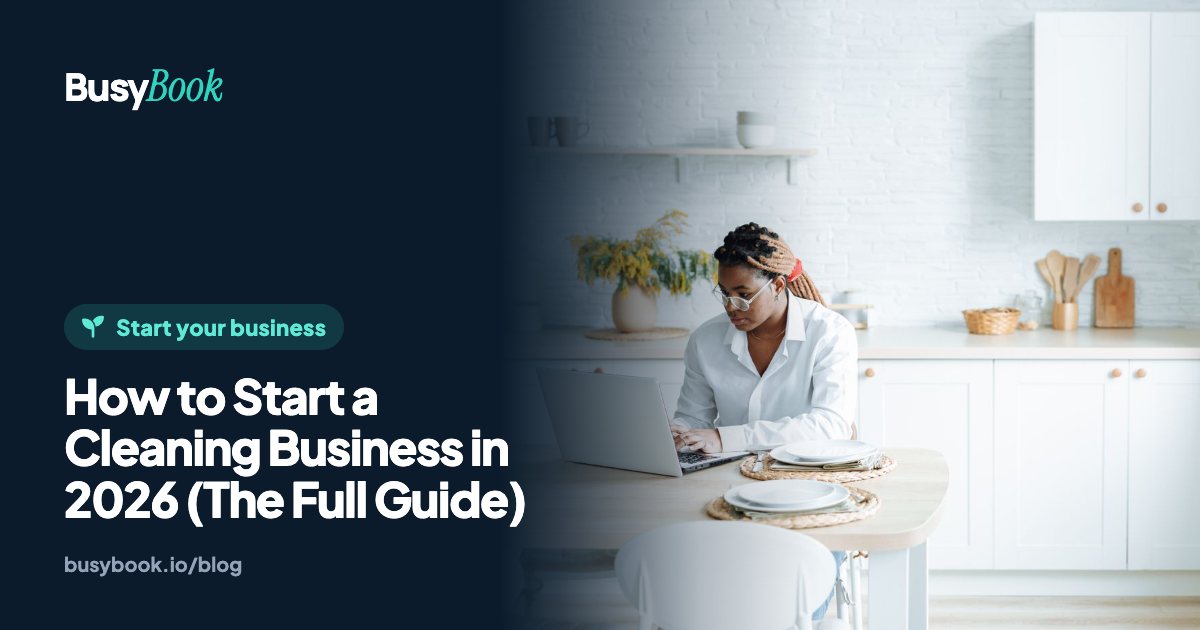
How to Start a Cleaning Business in 2026 (The Full Guide)
How to start a cleaning business in 2026, in the order I teach it: your market, paperwork, flat prices, partner cleaners, first clients and real costs.
When I started my cleaning business, I didn't know anything besides what a broom does, okay? I didn't have a business degree, I didn't have a plan, and I didn't have anybody telling me what to do first. So I did it the hard way, and I made a lot of mistakes, and every one of those mistakes is in this guide so you don't have to make them too.
This is the full road from "I'm thinking about it" to your first booked cleaning, in the order I teach it in my bootcamp. Order matters here, you guys, because most of the stress beginners feel comes from doing the right things in the wrong order, like paying for ads before you have a cleaner ready to take the job.
Read it top to bottom once, y'all, then come back to each step when you get there.
First, decide what kind of owner you want to be
There are two ways to start a cleaning business, and the steps look different for each one.
You clean the homes yourself. You find the clients, you do the work and you keep the whole price. It's a fine way to make money fast, and it's how I started, because I didn't know there was another option. I did the cleaning myself for my first month, and I know what it feels like to go home after two or three cleanings in one day so tired and so sore you can't think straight. The problem is that the business can only grow as far as your own two hands reach, right?
You run the business and partner cleaners do the work. Clients book with your company at a flat price, an independent contractor cleaner with their own supplies goes to the home, and you handle everything else: the pricing, the schedule, the clients and the money. This is what I teach, and it's how my business grew once I stopped doing the cleanings. With independent contractors doing the work, my business made $100,000 my first year and $150,000 my second year. Every market and every owner is different, so results vary, but that's the model this guide is built on.
If you already know you want the second one, I wrote a whole guide on how to start a remote cleaning business that goes deeper on running it from your phone. This guide covers the full picture either way.
Pick the kind of cleaning you'll sell
Cleaning is a big word, so pick a lane before you spend a dollar.
- Residential cleaning is cleaning people's homes, and it's where I tell most beginners to start. You'll sell three kinds of cleaning: a standard cleaning for a home that's kept up, a deep cleaning for a home that needs extra love, and a move-in or move-out cleaning for an empty home.
- Airbnb and short-term rental cleaning is turning a rental over between guests. It can be steady work, but the timing is tight and hosts are picky. I break it down in how to start an Airbnb cleaning business.
- Commercial cleaning is offices and businesses. The contracts can be bigger, but it's slower to land and it usually means night work.
- Post-construction cleaning is the dust and mess after a builder finishes. One of my students was about to close a $10,000 post-construction job within her first 30 days, so it can pay, but it's not where the steady money lives.
The steady money lives in recurring residential clients, the family who books you every two weeks and keeps booking. A one-time cleaning pays you once, and then you have to go find somebody new, right? A recurring client pays you every two weeks without you having to sell them again, and that's what builds a business that lasts.
Step 1: Pick your market on purpose
Don't pick your city because it's where you grew up or where your cousins live. Pick it because the numbers say people there pay for cleaning, okay?
When I look at a market, I'm looking at a few things:
- Median household income. Families with room in their budget keep their cleaning even when money gets tight, because to them it's a bill like the water and the power.
- Homes people own. Owners book recurring cleanings more often than renters do, and owners are the ones who call you twice a month.
- How close the homes are. You want a tight area where one partner cleaner can do two homes in the same day without sitting in traffic all morning.
- Demand you can see. Search "house cleaning near me" as if you lived there. Count the ads, count the reviews and look at how booked out the other companies are.
A lot of competition doesn't mean an area is full, you guys. If there are companies with 150 reviews running ads every day, that means money is already moving there, and you're stepping into demand that already exists instead of trying to invent it. No competition at all is the scary one, right?
And the beauty of running it remotely is that your business doesn't have to be where you live. I have students who live in one state and run their business in another, and I've never met most of my own cleaners face to face.
Step 2: Study 5 to 10 companies in that market
This is my favorite part, because I love research. Before I set a single price, I write down the top five to ten cleaning companies I can find on Google, Yelp, Thumbtack and Bark, and I study them.
Look at their prices and what extras they offer. Look at how you book them: can you book online at 10 at night, or do they make you call and wait for somebody to come look at your home first? Look at their website and their social media.
Then read their reviews, because reviews are the best free data you'll ever get. Clients tell you exactly what they love and exactly what drives them crazy. If you keep seeing "they're always late" or "they cancel all the time," you just learned what your business is going to do better.
While you're looking, decide who you want to be. Are you the Walmart, the Target or the Macy's of cleaning in your area? Pick on purpose, because your prices, your website and your words all follow from that choice, right?
Step 3: Make it a real business
This is the part people put off for three or four months. Please don't, y'all, because most of it takes a few days.
Your name. Keep it simple. Your area plus what you do works great, so people know what you are and where you are from the name alone. Search your state's Secretary of State website to make sure nobody else has it, and check that you can get the website address too. I can't tell you how many times I changed my company name in the beginning, so don't let picking the perfect one stop you.
Register it. Most owners either form an LLC or start with a DBA, which means "doing business as" and is sometimes called an assumed name. An LLC isn't required to start, and in some states it's expensive, so read do I need an LLC for a cleaning business? before you spend the money. Every state, county and city has its own rules about business licenses too, so check yours.
Get your EIN. It's your business's tax ID number, and it's free on the IRS website. Don't pay anybody to get it for you.
Get a business phone number. Not your personal cell. When I started, I did all the texting from my own phone, and clients were texting me at 9 at night and cleaners were calling during dinner, and everything blended together. I use Quo (formerly OpenPhone) now, and it gives you a business number on the phone you already have.
Get a business address you'd be proud of. If you use a virtual address, Google it before you pay. I tried to go the super cheap way once, and when I looked up the address, the picture that popped up was an alleyway in downtown Dallas. That's not what you want a client to find, okay?
Open a business bank account so your money is separate from day one. I explain how I set mine up in business bank accounts for a cleaning business.
Get insurance. General liability is where most owners start, and your partner cleaners carry their own. See cleaning business insurance for what to look for.
Step 4: Set flat prices that pay everybody
Pricing makes or breaks this business, so slow down right here.
Price by the home, never by the clock, okay? Every price is built from the type of cleaning (standard, deep or move-out), the bedrooms, the bathrooms, the square feet and any extras like the inside of the oven. When your price comes from a formula, the price is the price, and you're not making it up on every call.
In the model I teach, the client pays your business, your partner cleaner gets their share of the job, and the rest stays in the business. So your price has two jobs: it has to pay your partners well, and it still has to leave money for the business. If your prices only cover your cleaners, you didn't build a business, baby. You bought yourself a job.
Here's a simple example. Say your formula adds up to $300 for a deep cleaning and you pay your partners 50% of each job. Your partner earns $150, and $150 stays in your business for your marketing, your software, your insurance and your profit. That 50% is only an example, because the right share depends on your market and the cost of living there.
Most companies also give a discount for recurring cleanings, because a home cleaned every two weeks stays in better shape. The common ones I see in my research are around 20% for weekly, 15% for every two weeks and 10% for monthly. You don't have to match those, though. It's your business, so you control your prices, right?
Want to see your numbers? Try the free house cleaning price calculator, then read the full method in how to price house cleaning.
Step 5: Line up partner cleaners before your first client
I get this question all the time: do I find my cleaners or my clients first? Cleaners first, every time, you guys.
I learned this one the hard way. I had a job booked and no cleaner available, so I rushed to find somebody, and it did not end well. When you're in a rush, you settle for somebody without the experience or without the supplies, and your client feels it. It never ends well, so find your cleaners first and keep in touch with them while you get your first clients.
My minimum standards are at least two years of residential cleaning experience, their own supplies and equipment, their own transportation and their own insurance. Background checks are optional, but they give me peace of mind.
Look where cleaners are already looking for work: Indeed, Craigslist, Facebook Marketplace, Nextdoor and your local Facebook groups. One trick I love is the local community group. When somebody posts "can anyone recommend a cleaner?", look at who answers as themselves, like "I can clean this for you." Those are cleaners advertising their own business, so reach out and ask if they have room for more clients.
When you reach out, make it clear this is a partnership. Something like:
Hi, this is Jazmine. I own a small cleaning company here in Dallas, and I'm looking to partner with reliable independent cleaners. Do you have room to take on new clients?
It's a numbers game, so don't get discouraged, okay? Out of 100 cleaners you reach out to, maybe 20 meet your standards, and maybe two make it all the way through your process. Two good partners can carry a lot of jobs, so keep the list going.
I started with one cleaner, but I think the sweet spot is three, so somebody's always ready if one gets sick or goes on vacation. You are not the backup, okay? The whole guide is how to find cleaners for your cleaning business, and before anybody starts, read 1099 vs W-2 cleaners, because every state has its own rules about contractors.
Step 6: Set up booking, payments and a simple website
Clients today don't want to call you and play phone tag. They want to tap a button on their phone at 10 at night, see the price, pick a time and be done, right?
So you need three things working together:
- A booking page that prices the home from the bedrooms, bathrooms and square feet, and lets the client pick a date.
- A way to take payment, so the card is saved when they book and charged when the cleaning is done.
- A simple website that says what you clean, where you clean and how to book. One page is fine. Bookable beats beautiful.
Before you go live, do a test booking all the way through, start to finish. Book your own cleaning with a big discount, and watch the payment go through and the confirmation come in. If something's broken, you want to find out now and not with your first real client, right?
This is the part Busy Book does for you, by the way. Your booking page prices every home from your own formula, the client's card is saved through your own Square or Stripe account, and your website comes with it. See it all on the Features page.
Step 7: Get your first clients where people are already searching
Your first clients almost never come from Instagram, you guys. Social media is visibility, but a beginner needs demand, which means places where people are searching for a cleaner today.
- Google Business Profile. It's free, and it's how you show up on Google Maps. Set it up the right way with Google Business Profile for cleaning businesses.
- Thumbtack and Yelp. People there need a cleaner now, not someday. Thumbtack has always been my fastest way to get the first leads coming in, and I made over $200,000 on Thumbtack alone. Results vary, and it's not right for everybody, so read is Thumbtack worth it? first.
- Your own people. Text everybody in your phone. Let them know you opened a cleaning business, and ask for a booking or a referral.
- Property managers and realtors. Every move-out needs a cleaning, all year long, and every listing needs to shine before it's shown.
When you call a property manager's office, keep it simple:
Hi, I own a local cleaning company in the area. When units turn over, who handles your move-out cleanings? I'd love to be your backup when your regular company is booked.
Then show up every single time they call, y'all, and that backup spot turns into the first call.
And get reviews from day one, because reviews are your currency. A client who's choosing between you and somebody else is reading your reviews to decide if you're real. My rule of thumb is that five reviews equal one booked client, so ask after every single cleaning. The full playbook is in how to get cleaning clients.
Step 8: Answer fast and keep the quote short
The business that answers first usually gets the job. If a lead waits three hours, you probably already lost them, right?
When somebody asks for a price, ask a couple of questions first: how many bedrooms and bathrooms, when they last had a deep cleaning, whether they have pets and if it's one time or every two weeks. Then give the price and the next step in one breath:
Based on your home size and what you picked, your total is $325. Do we have availability on Thursday or Friday?
Then stop talking, you guys. Don't over-explain and don't offer a discount nobody asked for. If they say it's more than they expected, you can say, "I hear you. Our prices include vetted, reliable cleaners, and if anything isn't right, we'll make it right." Then let them think.
If you're working a 9 to 5, answering fast is the hard part, and that's exactly why Busy Book comes with Sarah, an AI assistant who texts every new lead within a minute, day or night, quotes your flat price and books the cleaning. You can read every conversation and jump in anytime.
Step 9: Put the money back in and watch your numbers
When the first payments come in, don't go buy a new bag, okay? Not yet. Put that money back into your marketing.
I started with $25. I booked a job with it, took the profit and put it back in, and I kept doing that until my budget went from $25 a week to $100 a week, then $500 a week and then $1,000 a week. That snowball is how you grow when you don't have a big pile of money to start with, right?
Then look at your numbers every week, not your feelings. How many leads came in, where did they come from, how many booked and which platform brought the clients who stayed? Make your decisions from the facts, and you'll stop wasting money on what isn't working.
What it costs to start a cleaning business
Most owners can start for a few hundred dollars plus a monthly budget, because your partner cleaners bring their own supplies and equipment. Your biggest costs are usually your state's registration fees, insurance, your phone and software, and your marketing.
I break down every line in cleaning business startup costs, and the free startup cost calculator adds it up for your state and your budget.
What you can expect to make
I'm not about to sell you no fantasy, so let's look at the real math. A cleaning in my world often runs around $250. If one partner cleaner does about 10 of those a week, that's around $10,000 a month moving through your business from one person who isn't you. After you pay your partner their share, the business keeps a part of that, and in my experience that's been around $4,000 a month for one full-time partner at those numbers. Your prices, your market and your partner share change all of it, so results vary.
This isn't passive, either. Cleaners cancel. A client will have an opinion about the baseboards. You'll handle it, and you'll get better at handling it every time. It really does work if you work it.
A launch plan in four weeks
This is how I lay it out for my bootcamp classes, and you can follow the same rhythm on your own:
| Week | What you do |
|---|---|
| Week 1 | Pick your market, study your competition, register the business and set up your phone, bank account and booking page |
| Week 2 | Get visible: Google Business Profile, Thumbtack, Yelp and your website, and start reaching out to partner cleaners |
| Week 3 | Get ready to sell: your prices, your quote script, your first partners lined up and a test booking done |
| Week 4 | Go live: turn the platforms on, answer every lead fast and book your first clients |
Some people move faster and some people move slower, and both are fine, you guys. Run your own race.
The mistakes I see most
- Marketing before structure. Marketing amplifies whatever you built. If the back end is shaky, ads just bring you more stress.
- Pricing too low. You lose your best cleaners and you attract the clients who haggle.
- Finding clients before cleaners. Then you're rushing, and rushing never ends well.
- One cleaner and no backup. One sick day and you're either cleaning or cancelling.
- Using your personal phone. Everything blends together, and you never get a break.
- Waiting to feel ready. You can be scared and still start. All those shoulda coulda wouldas? Out the door.
If you're building this next to a full-time job, read how to start a cleaning business while working full time. It shows what your week can actually look like.
Watch me walk through it

Questions people ask
How do I start a cleaning business with no experience?
Partner with experienced cleaners and focus on the business side. I look for cleaners with at least two years of residential experience, so they bring the cleaning know-how. You bring the market research, the prices, the clients and the follow-through.
How much money do I need to start a cleaning business?
Most owners start with a few hundred dollars plus a monthly marketing budget, because partner cleaners bring their own supplies. Your state's fees and your insurance change the total. The startup cost calculator adds it up for you.
Do I need a license to start a cleaning business?
Most places don't have a special cleaning license, but many states, counties and cities require a general business license or a registered business name. Check with your Secretary of State and your city or county, because the rules are different everywhere.
Is a cleaning business profitable?
It can be, because the startup costs are low and people need their homes cleaned every few weeks. Profit comes from flat prices that pay your partners well and still leave money for the business, plus recurring clients. Every market is different, so results vary.
How long does it take to start a cleaning business?
You can be set up and taking bookings in about four weeks if you follow the steps in order. Some owners take longer because of their state's paperwork or their schedule, and that's okay.
How do I get my first cleaning client?
Start where people are already searching for a cleaner, like Google, Thumbtack and Yelp, and tell everybody you know. Answer every lead fast with a clear flat price and a choice of two days.